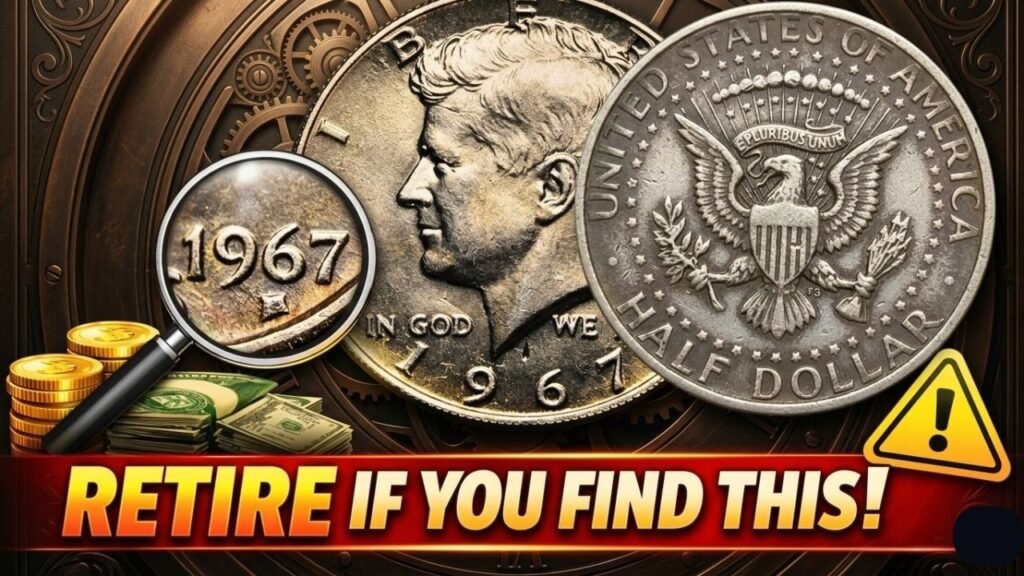
1967 Kennedy Half Dollar : Ever wonder if that old coin sitting in your grandma’s jewelry box could actually be worth something? The 1967 Kennedy Half Dollar might look like just another piece of change, but some versions of this coin are selling for more than a used car. After President John F. Kennedy was assassinated in 1963, the U.S. Mint created this coin to honor him. By 1967, something interesting was happening with these coins, and collectors today are willing to pay big money for the right ones. Let’s break down what makes this fifty-cent piece so special and how you might spot a valuable one in your own pocket change.
What Makes the 1967 Half Dollar Different?
Back in the mid-1960s, the United States was running out of silver. The government passed the Coinage Act of 1965, which started changing how coins were made. For the Kennedy Half Dollar, this meant two things. First, between 1965 and 1967, the Mint stopped putting mint marks on coins, so every 1967 half dollar has no letter under Kennedy’s neck. Second, these coins still contain 40% silver, unlike today’s half dollars that are just copper and nickel. This silver content alone means every single 1967 half dollar is worth more than fifty cents, even if it’s beat up and ugly.
1967 Kennedy Half Dollar at a Glance
| Feature | Details |
|---|---|
| Year Minted | 1967 |
| Face Value | 50 cents ($0.50) |
| Metal Composition | 40% Silver, 60% Copper |
| Total Weight | 11.5 grams |
| Pure Silver Content | 0.1479 troy ounces |
| Mint Marks | None (all coins from 1965-1967 have no mint mark) |
| Mintage | Millions produced, exact numbers vary |
| Special Versions | Special Mint Set (SMS), Cameo, Deep Cameo |
| Circulated Value | $5 to $10 depending on silver prices |
| SMS Value | $15 to $30 for regular, $100+ for cameo |
| Top Rarity Value | $12,000 to $30,000+ for perfect Deep Cameo SMS |
How Much Is a Regular 1967 Half Dollar Worth?
If you find a 1967 Kennedy Half Dollar that looks like it’s been through a washing machine a few times, don’t get too excited yet. Circulated coins, the ones with lots of scratches and worn-down details, usually sell for somewhere between $5 and $10. That’s still ten to twenty times its face value, which isn’t bad for finding a coin in your couch cushions. The exact price depends on the current price of silver, which goes up and down. But remember, this is the everyday version. The really valuable ones look like they just came from the factory.

The Special Mint Set Coins That Collectors Love
Here’s where things get interesting. In 1967, instead of making proof coins for collectors, the Mint created something called Special Mint Sets or SMS coins. These were struck with extra care and have sharper details than regular coins. A standard SMS 1967 half dollar in great condition might sell for $15 to $30. But if the coin has something called “cameo contrast,” where the design looks frosted and the background looks like a mirror, the price jumps to $100 or more. The holy grail is the Deep Cameo SMS coin in perfect condition, which can sell for $12,000 to over $30,000 at auction.
Error Coins: When Mistakes Pay Off
Everybody makes mistakes, and the U.S. Mint is no different. Sometimes coins get messed up during production, and those errors can make them super valuable to collectors. With the 1967 Kennedy Half Dollar, you might find coins that were struck off-center, meaning the design isn’t centered properly. Double die errors show doubling on the words or Kennedy’s portrait. There are also coins with planchet errors, where the metal blank itself was wrong. Depending on how dramatic the error is, these coins can be worth anywhere from a couple hundred dollars to several thousand. Keep your eyes open!
Should You Collect These Coins?
The Kennedy Half Dollar series is one of the most collected in American history, and the 1967 issue has some cool advantages. First, because it contains real silver, its value will never drop below its melt price. Second, the hunt for SMS varieties and errors makes collecting fun and exciting. You don’t have to be a millionaire to start, either. You can buy circulated examples for just a few dollars and work your way up. Plus, there’s always the chance you’ll find a valuable coin in unexpected places, like at garage sales, in old piggy banks, or even in rolls of half dollars from the bank.
Could One Coin Really Change Your Retirement?
Let’s be real here. Most 1967 Kennedy Half Dollars are not going to make you rich. Your average beat-up coin is just a cool piece of silver with some historical value. But the rare ones, especially the Deep Cameo SMS coins in perfect condition, absolutely can be life-changing finds. Imagine finding a coin worth $30,000 in your grandpa’s old coin collection. Even the mid-range collectible coins can put a nice chunk of change in your pocket. The key is knowing what to look for and not spending valuable coins at the store just because they say fifty cents on them.
Collector Tips for Finding Valuable Coins
- Look closely at the surface – SMS coins have smoother, more detailed surfaces than regular circulation coins. Compare side by side if you can.
- Check for cameo contrast – Hold the coin under a good light. If Kennedy’s portrait looks frosty white against a mirror-like background, you might have something special.
- Examine the edges – Error coins sometimes have weird edges or missing reeding (the lines around the outside).
- Get a magnifying glass – Small details like double die errors are hard to see with the naked eye. A 10x magnifier helps spot valuable mistakes.
- Never clean old coins – Cleaning actually destroys value. Collectors want coins in their original condition, even if they’re a little dirty.
- Check your change – Yes, people still accidentally spend these! Ask your parents and grandparents to check their old coins too.
Frequently Asked Questions
Q: How can I tell if my 1967 Kennedy Half Dollar is valuable?
A: Look at its condition first. If it looks shiny and new with sharp details, it could be worth more. Check for frosted designs against a mirror background, which indicates a valuable SMS cameo coin. Any weird errors or off-center strikes also add value. When in doubt, have a coin dealer look at it.
Q: Why doesn’t my 1967 half dollar have a mint mark?
A: The U.S. Mint removed mint marks from all coins between 1965 and 1967 because of a coin shortage. They wanted people to stop hoarding coins by mint mark. So every 1967 half dollar, whether made in Philadelphia, Denver, or San Francisco, looks the same with no mint mark.

Q: Is the 1967 Kennedy Half Dollar real silver?
A: Yes, but only 40% silver. The rest is copper. This is different from the 1964 version which was 90% silver, and different from modern half dollars which have no silver at all. The 40% silver was used from 1965 to 1970.
Q: Where can I sell my 1967 Kennedy Half Dollar if it’s valuable?
A: You have several options. Local coin shops are good for quick sales. Coin shows let you meet multiple buyers. Online auction sites like eBay reach many collectors but take fees. For really valuable coins, consider professional auction houses that specialize in rare coins.
Q: How much silver is actually in a 1967 half dollar?
A: Each coin contains about 0.1479 troy ounces of pure silver. At today’s silver prices, that’s worth around $3 to $4 just for the metal. This is why even worn-out coins are worth keeping instead of spending.

Q: What’s the difference between SMS and regular 1967 half dollars?
A: SMS stands for Special Mint Set. These were made specially for collectors with better equipment and more care. They have sharper details, smoother surfaces, and sometimes cameo contrast. Regular coins were made for everyday use by the millions and usually show more wear and less detail.
Remember: Coin values change based on market demand and silver prices. For the most current values, check with multiple coin dealers or recent auction sales.